

Australian construction projects are becoming increasingly complex. Service congestion, tighter NCC compliance requirements, and rising labour costs are placing significant pressure on contractors. In this environment, BIM in MEP Construction is not simply a modelling upgrade. It is a structured coordination and risk management framework.
Mechanical, electrical and plumbing systems are responsible for the majority of on-site clashes and rework. Therefore, leading builders and consultants now rely on structured MEP BIM Australia workflows to resolve conflicts digitally before installation begins.
This guide explains how BIM works technically, how it transforms MEP coordination, how it aligns with Australian standards, and why it delivers measurable return on investment.
Understanding BIM in MEP Projects
Building Information Modelling (BIM) is a process that integrates 3D geometry with structured data and coordinated workflows. However, BIM is more than visual modelling. It connects disciplines within a controlled information environment.
- Parametric object-based modelling
- Embedded performance data
- Federated discipline coordination
- Common Data Environment (CDE)
- Version control and audit trails
When applied to MEP systems, BIM enables digital coordination before site mobilisation, reducing uncertainty and installation risk.
What MEP Means in Construction
- Mechanical: HVAC, ductwork, chilled water, plant rooms
- Electrical: Cable trays, switchboards, lighting, fire systems
- Plumbing: Hydraulics, sewer, stormwater, gas services
These systems compete for limited ceiling and riser space. Consequently, digital coordination becomes essential.
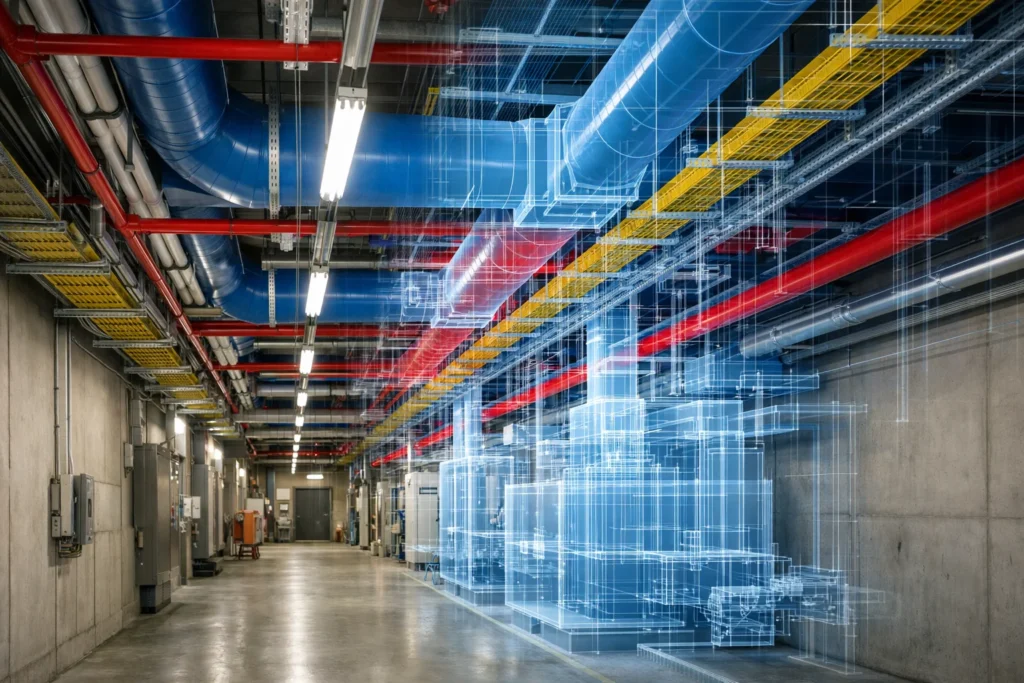
How Digital Coordination Improves MEP Workflow
Traditional CAD-Based Process
- Separate 2D drawings
- Manual overlay coordination
- Clashes discovered during construction
- Reactive site adjustments
This approach increases rework, delays and cost exposure.
Modern BIM Workflow for MEP
- Architectural and structural models issued
- Revit MEP modelling developed per discipline
- Federated coordination model created
- Clash detection analysis performed
- Coordination workshops resolve issues
- LOD 400 fabrication models issued
- LOD 500 as-built model delivered
As a result, installation becomes predictable and constructability improves significantly.
LOD 200 300 400 MEP Explained
LOD 100 – Concept Stage
Generic system placeholders and approximate capacity.
LOD 200 – Design Development
Preliminary routing and spatial validation.
LOD 300 – Coordination Level
Accurate dimensions, real routing, and verified clearances.
LOD 400 – Fabrication Level
Spool drawings, hanger positions and manufacturer-specific detail.
LOD 500 – Asset Integration
Verified installed condition with lifecycle asset data.
Most Australian commercial projects coordinate services at LOD 300–400.
Clash Detection and MEP Coordination
Clash detection is a core capability within BIM workflows.
- Hard clashes: Physical intersections
- Soft clashes: Clearance violations
- Workflow clashes: Maintenance access conflicts
Using coordination software, project teams identify and resolve conflicts before construction. Therefore, site disruption is significantly reduced.
Traditional CAD vs Modern BIM for MEP Projects
The following comparison highlights how structured BIM workflows outperform traditional drafting methods in complex Australian projects.
| Feature | Traditional CAD | BIM Workflow |
|---|---|---|
| Coordination | Manual overlays | Automated clash detection |
| Quantities | Manual take-off | Model-based extraction |
| Prefabrication | Limited | Enabled at LOD 400 |
| Risk | High | Significantly reduced |
| Lifecycle Data | Minimal | LOD 500 asset integration |
Cost Savings and ROI of MEP BIM Australia
Although BIM requires upfront modelling investment, it reduces downstream cost exposure.
- Reduced rework
- Fewer variation claims
- Improved procurement accuracy
- Enhanced prefabrication efficiency
- Shorter project duration
Because MEP systems represent a major portion of construction cost, even moderate efficiency improvements deliver measurable return on investment.
BIM Standards Australia 2026
NCC Alignment
In Australia, building services must comply with the National Construction Code (NCC), which governs fire safety, accessibility, energy efficiency and system performance.
BIM enables project teams to digitally verify fire-rated penetrations, service clearances, riser spacing and access zones before construction begins. As a result, compliance risks are identified early rather than during inspection or installation.
ISO 19650 Information Management
Australian BIM projects increasingly align with ISO 19650, the international standard for structured information management.
This framework defines how models are named, shared, reviewed and controlled within a Common Data Environment (CDE). When properly implemented, it reduces data confusion, prevents version conflicts and ensures accountability across disciplines.
Professional BIM service providers structure workflows according to these principles to maintain consistency and auditability throughout the project lifecycle.
Scan to BIM for Existing Assets
For refurbishment and retrofit projects, accurate existing-condition data is critical.
Scan to BIM converts laser-scanned point cloud data into coordinated 3D models of the current building. This allows new MEP systems to be designed around real site conditions, preventing costly unknown clashes during construction.
Future Outlook: BIM in Australia 2026–2030
- Digital twin integration
- 4D scheduling
- 5D cost modelling
- AI-assisted clash grouping
- Automated compliance validation
Consequently, structured BIM capability will remain essential for competitive MEP contractors.
Frequently Asked Questions
What is BIM in MEP Construction?
It is the structured digital coordination of mechanical, electrical and plumbing systems using data-rich 3D models.
What LOD is required for coordination?
Most commercial projects coordinate at LOD 300 and develop fabrication detail at LOD 400.
How does clash detection work?
Federated discipline models are tested against defined rules to identify and resolve conflicts before installation.
Is BIM mandatory in Australia?
Many government and Tier 1 projects require ISO-aligned BIM deliverables.
What is Scan to BIM?
It converts laser-scanned data into structured BIM models for renovation and asset management.
Why does BIM reduce project risk?
Because services are coordinated digitally before construction begins, reducing site conflicts and variation claims.
Conclusion
BIM in MEP Construction Australia has evolved from a coordination enhancement into a fundamental project delivery strategy. In 2026, it is no longer viewed as an optional digital upgrade. Instead, it is recognised as a structured framework that underpins risk mitigation, compliance validation, and buildability assurance across complex developments.
National Construction Code (NCC)
As building services become increasingly dense and compliance obligations under the NCC continue to tighten, traditional coordination methods cannot adequately manage spatial conflicts, documentation control, or lifecycle asset integration. BIM addresses these challenges by shifting coordination from reactive, site-based problem solving to proactive, model-based validation. This transformation reduces rework, improves programme certainty, and strengthens commercial outcomes for all stakeholders.
Furthermore, structured MEP coordination through BIM enhances collaboration between architects, structural engineers, services consultants, subcontractors, and builders. Clear digital workflows aligned with ISO 19650 principles improve information reliability and reduce ambiguity during procurement, fabrication and installation stages. As a result, project teams gain greater transparency, accountability, and constructability confidence before site mobilisation.
From a financial perspective, the return on investment is measurable. Reduced clashes, improved prefabrication capability, optimised material ordering, and minimised variations directly impact project margins. For developers and asset owners, the delivery of LOD 500 models provides long-term operational value through structured asset data and lifecycle management integration.
Most importantly, BIM in MEP Construction Australia is now a competitive differentiator. Major infrastructure projects and Tier 1 commercial developments increasingly require structured BIM deliverables as a baseline expectation. Contractors without advanced coordination capability face higher risk exposure and reduced eligibility for complex tenders.
For builders, consultants and MEP contractors seeking predictable project outcomes, structured BIM implementation aligned with Australian standards is no longer optional. It is a strategic requirement. Firms that invest in disciplined BIM workflows, experienced coordination leadership, and standards-compliant execution will consistently deliver safer, more efficient and commercially resilient projects in the evolving Australian construction landscape.