
BIM Building Maintenance: How BIM Improves Facility & Asset Management in Australia
Large Australian facilities are becoming increasingly complex. Hospitals operate 24/7 under strict compliance controls. Universities manage ageing campus infrastructure. Commercial towers depend on tightly coordinated mechanical, electrical, hydraulic and fire systems. Yet many asset owners still rely on fragmented documentation, outdated drawings, disconnected O&M manuals and isolated CAFM databases. This creates reactive maintenance cycles, avoidable downtime and long-term cost escalation. BIM Building Maintenance changes that operating model. When implemented correctly at LOD 500 level, BIM becomes a structured asset intelligence platform that supports lifecycle management, compliance, preventive maintenance and strategic capital planning.
What Is BIM Building Maintenance?
BIM Building Maintenance refers to the structured use of a verified as-built BIM model to manage building assets during the operational phase.
Unlike design BIM, operations-focused BIM prioritises:
- Verified asset locations
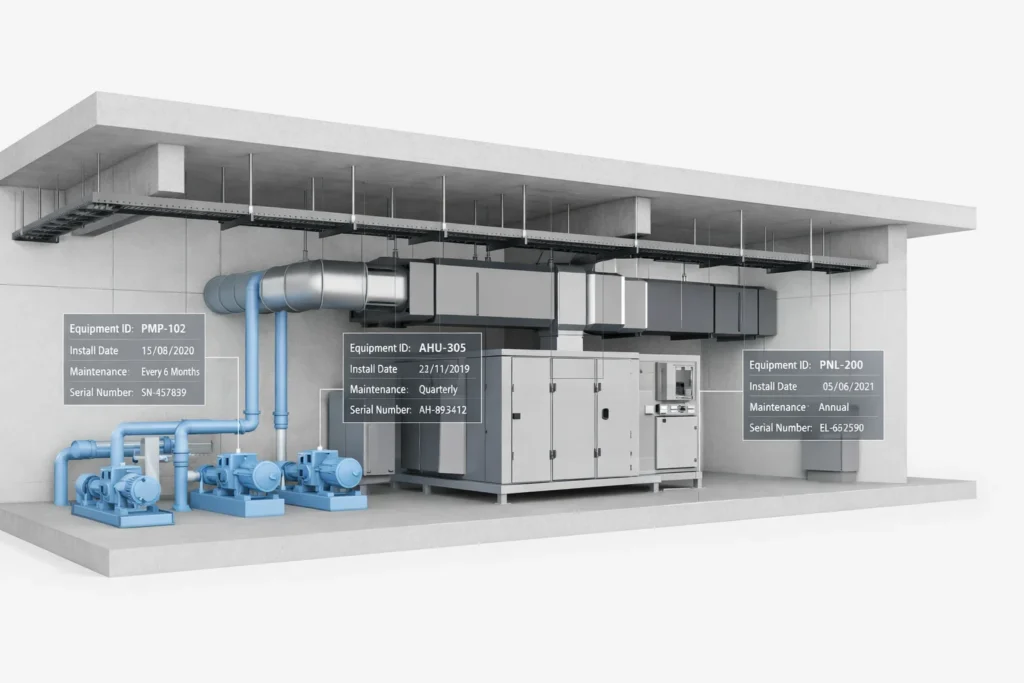
- Embedded equipment metadata
- Maintenance schedules
- Warranty and commissioning data
- Integration with FM and CAFM systems
This approach transforms static construction deliverables into operational intelligence.
From Construction to Operations: The BIM Lifecycle Shift
Most Australian BIM projects peak during coordination (LOD 300–350) or fabrication (LOD 400). However, lifecycle value is unlocked only when the model transitions into operations.
This transition requires:
- Verification of installed conditions
- Final asset tagging
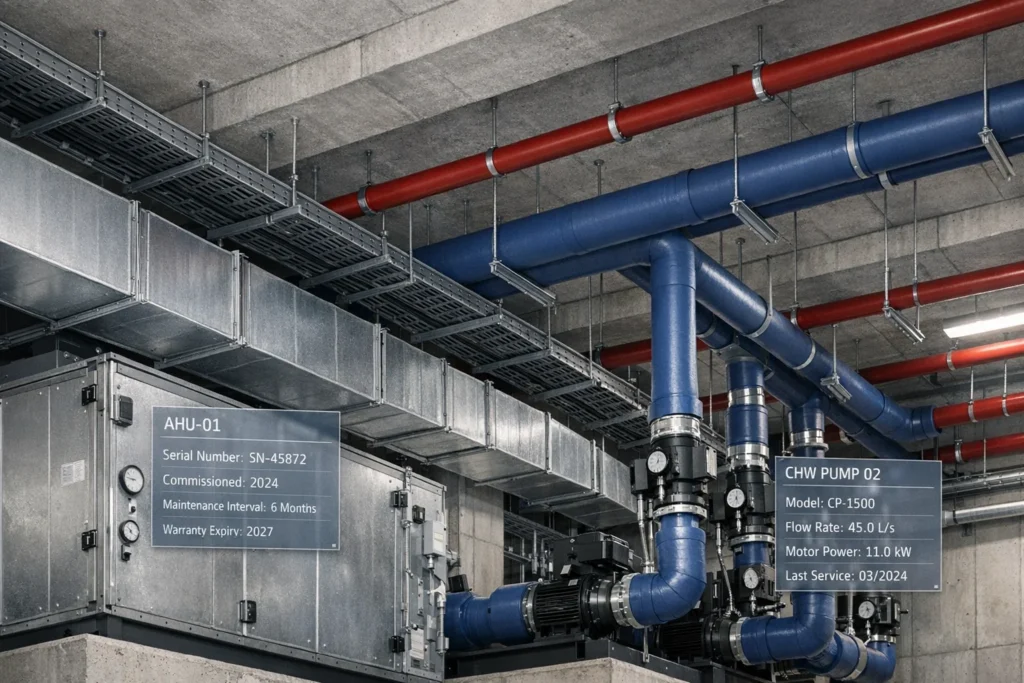
- Serial number capture
- Structured O&M documentation linking
- COBie dataset preparation
Without this structured transition, BIM becomes archival rather than operational.
LOD 500 BIM Australia: The Foundation of Maintenance Accuracy
In the context of LOD 500 BIM Australia, geometry is field-verified and aligned with installed conditions.
LOD 500 includes:
- Accurate asset positioning
- Confirmed routing offsets
- Installed equipment metadata
- Final penetrations and supports
- Commissioning status
For facility managers, this eliminates uncertainty during shutdown planning and maintenance interventions.
Asset Information Model (AIM)
An Asset Information Model (AIM) structures the operational dataset extracted from the BIM model.
The AIM typically contains:
- Asset IDs
- Manufacturer and model details
- Warranty periods
- Maintenance intervals
- Service history fields
- Compliance documentation references
Geometry provides spatial intelligence. The AIM provides operational intelligence.
FM BIM Integration
BIM for facility management requires integration with CAFM, CMMS or enterprise asset management systems.
This is achieved through:
- Structured COBie exports
- Asset ID mapping
- Maintenance schedule synchronization
- Data exchange protocols
Through FM BIM integration, maintenance teams can click on an asset within the model and access service history, O&M manuals and inspection records instantly.
Step-by-Step BIM Building Maintenance Workflow
1. As-Built BIM for Operations
Field verification or Scan to BIM processes ensure the model reflects installed conditions.
2. Asset Data Enrichment
Equipment metadata is embedded within model elements.
3. COBie Data Integration
Structured asset information is prepared for FM system integration.
4. O&M Documentation Linking
Manuals, certificates and commissioning reports are connected to assets.
5. Preventive Maintenance Scheduling
Maintenance intervals are structured and synchronised with CMMS platforms.
6. BIM Lifecycle Management
Long-term performance tracking and capital forecasting are enabled.
Digital Twin Building Maintenance vs BIM
Digital twin building maintenance builds upon BIM. BIM provides verified structured data. A digital twin connects that data to live sensor inputs and real-time performance analytics.
Without an accurate LOD 500 foundation, digital twin initiatives lack reliability.
Benefits of BIM for Asset Management
| Benefit | Operational Impact |
|---|---|
| Reduced Downtime | Faster fault identification and access planning |
| Improved Asset Visibility | Centralised, structured equipment database |
| Lifecycle Cost Control | Data-driven capital replacement planning |
| Compliance Support | Audit-ready documentation and inspection tracking |
| Strategic Decision Making | Performance-based asset optimisation |
Common BIM Handover Mistakes
- Delivering coordination models instead of LOD 500
- Incomplete asset metadata
- Unstructured COBie datasets
- No FM system alignment
- Treating BIM as design-only deliverable
Conclusion: BIM Building Maintenance as a Strategic Asset
BIM Building Maintenance is not a software exercise. It is a lifecycle strategy. When aligned with international standards such as ISO 19650-1 and ISO 19650-2,
asset owners establish structured information governance across the building lifecycle. For Australian hospitals, universities, commercial towers and infrastructure operators, structured LOD 500 implementation transforms BIM into an operational intelligence platform. Organisations seeking to implement lifecycle-focused BIM, asset digitisation or LOD 500 modelling strategies can review our national delivery capability across Australia here:
MeterBuilt Offices. To understand our lifecycle BIM methodology and digital asset management approach, visit: About MeterBuilt. When structured correctly, BIM evolves from a construction deliverable into a long-term operational asset supporting resilience, compliance and financial performance.