Construction Drawings vs Shop Drawings – Key Differences Explained
The distinction between Construction Drawings vs Shop Drawings is one of the most misunderstood aspects of commercial construction documentation in Australia. While both document types are essential to project delivery, they serve fundamentally different technical, contractual, and operational purposes.
For builders, subcontractors, consultants, and developers, misunderstanding this difference can result in fabrication errors, coordination clashes, approval delays, and commercial risk exposure. This guide provides a technically precise explanation grounded in real Australian project workflows.
What Are Construction Drawings?
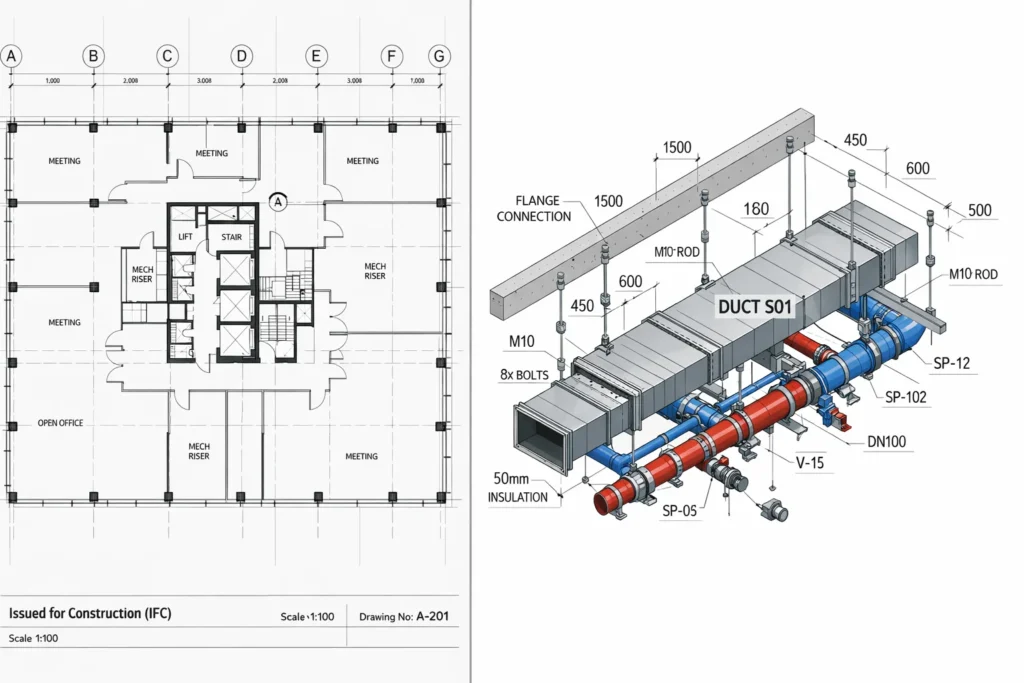
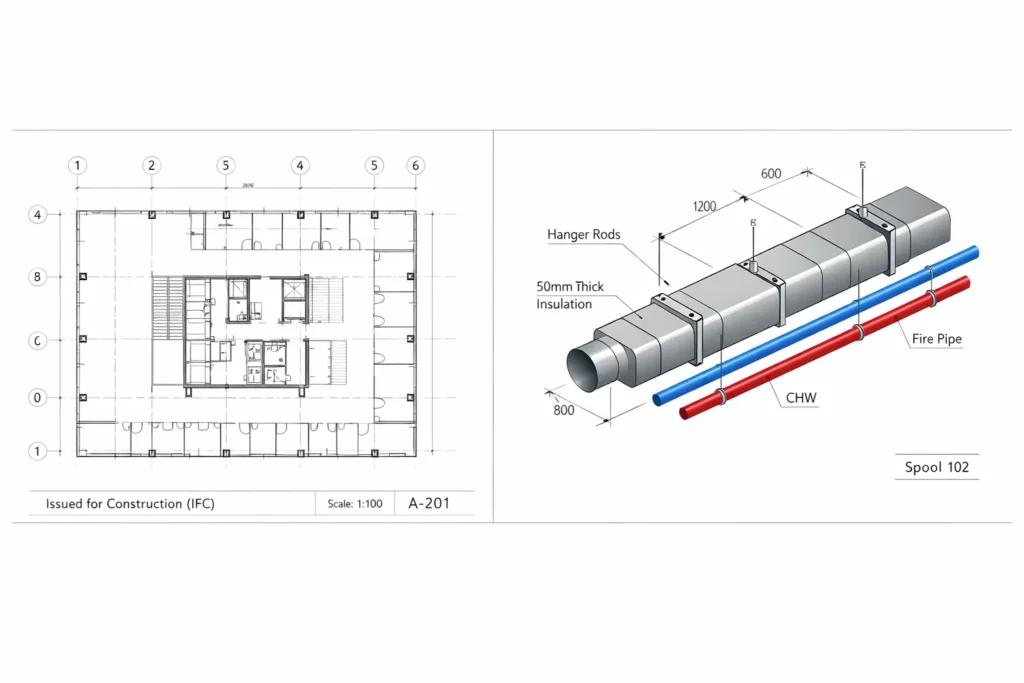
Construction drawings—often referred to as IFC (Issued for Construction) or Approved for Construction drawings—are design-authority documents prepared by architects and engineering consultants. They communicate design intent and establish compliance with:
- National Construction Code (NCC)
- Australian Standards
- Project specifications
- Performance requirements
They define layout, system intent, materials, dimensions, and regulatory compliance. However, they are not fabrication-level documents.
What Are Shop Drawings?
Shop drawings are contractor-generated documents that translate design intent into fabrication-ready and installation-ready detail. They are prepared by subcontractors or fabricators after contract award.
Shop drawings define exact dimensions, offsets, connection types, hanger locations, spool breakdowns, and constructability logic.
In services projects, these include:
- MEP shop drawings
- Fabrication drawings
- BIM shop drawings
Construction Drawings vs Shop Drawings – Technical Comparison
| Category | Construction Drawings | Shop Drawings |
|---|---|---|
| Prepared By | Architects & Engineers | Contractors / Fabricators |
| Purpose | Design intent | Fabrication & installation |
| Detail Level | General arrangement | Fabrication precision |
| Contract Status | Contract document | Submittal for approval |
| Dimensions | Indicative | Verified site dimensions |
| LOD Alignment | Typically LOD 300 | Typically LOD 400 |
Who Prepares Each Drawing Type?
Construction documentation is produced by design consultants. Shop drawings are produced by contractors responsible for delivery and installation.
When Are They Produced?
Construction drawings are issued during the detailed design phase and before construction commencement. Shop drawings are produced after contractor engagement and before fabrication.
Legal and Contractual Responsibility
Construction drawings form part of the legal contract. Shop drawings remain the responsibility of the contractor, even after consultant review.
Role in BIM and Modern Coordination
With BIM workflows, both documentation types have evolved. Construction drawings are now generated from coordinated 3D models. Shop drawings are often derived from LOD 400 fabrication models and used for prefabrication and CNC-driven manufacturing.
Industry standards for digital construction data exchange are guided globally by buildingSMART standards, which define interoperability frameworks such as IFC (Industry Foundation Classes).
Common Misunderstandings
- IFC drawings are fabrication-ready – incorrect.
- Approval of shop drawings transfers design liability – incorrect.
- Shop drawings are optional on commercial projects – incorrect.
Australian Commercial Project Example
On a multi-storey Sydney office tower, consultants issue coordinated IFC drawings. The mechanical contractor then develops LOD 400 BIM shop drawings, resolves ceiling congestion, confirms penetrations, and submits for approval. Fabrication proceeds only after formal approval. This workflow prevents rework and protects programme certainty.
Risk Implications
Misinterpreting Construction Drawings vs Shop Drawings can result in:
- Clashes in ceiling voids
- Re-fabrication costs
- Programme delays
- Variation claims
- Compliance breaches
FAQ
Are construction drawings legally binding?
Yes. They form part of the contract documentation and define compliance obligations.
Can shop drawings override construction drawings?
No. Any deviation requires formal approval.
Who prepares MEP shop drawings?
Typically mechanical, electrical, hydraulic, and fire subcontractors.
What level of detail are shop drawings?
Usually aligned with LOD 400 fabrication-level modelling.
When are as-built drawings prepared?
At project completion to reflect installed conditions.
Do all projects require shop drawings?
Commercial and infrastructure projects almost always require them.
Final Perspective
The difference between Construction Drawings vs Shop Drawings is structural, contractual, and operational. Construction drawings define design intent. Shop drawings transform that intent into buildable, fabrication-ready reality.
On complex Australian projects, documentation precision directly affects risk exposure and delivery certainty. Aligning documentation practices with international interoperability standards such as those defined by buildingSMART ensures consistency in digital construction workflows.
For projects requiring coordinated BIM documentation, fabrication-ready MEP shop drawings, or advanced construction documentation support, specialist involvement at early stages reduces risk and prevents costly site rework.
Learn more about professional BIM and shop drawing services at MeterBuilt Services or connect with regional teams through MeterBuilt Offices.
Precision in documentation is not administrative detail. It is a commercial safeguard.