
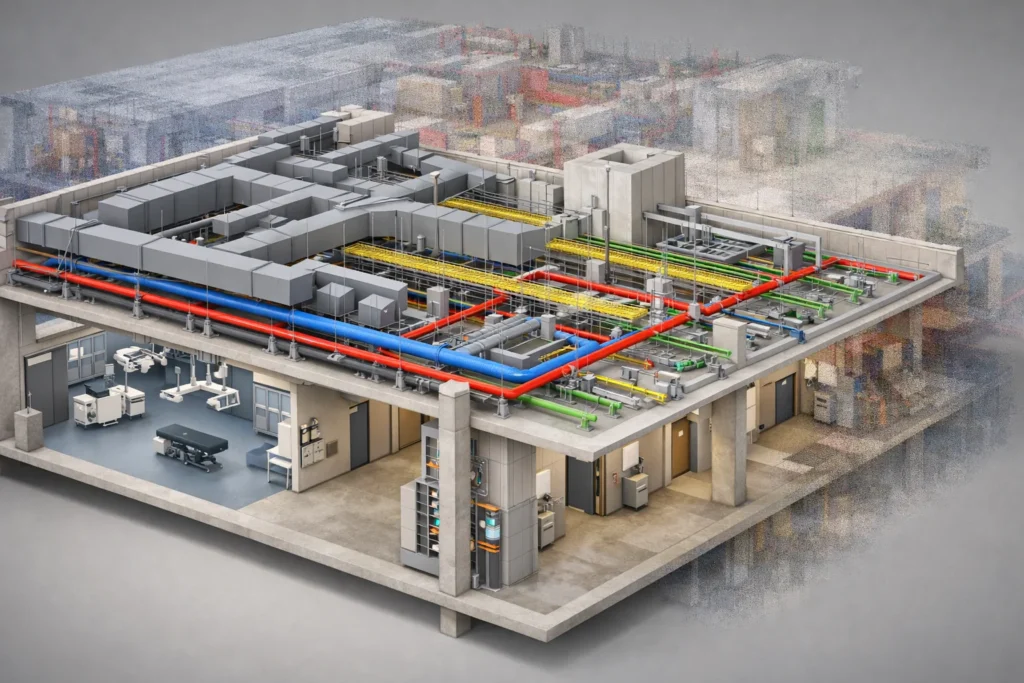
Scan to BIM Process: From Point Cloud to As-Built Model
The Scan to BIM Process has become a critical workflow in Australian construction, infrastructure upgrades, healthcare refurbishments, and commercial retrofits. Across Australia, many existing buildings lack reliable documentation. Original drawings are outdated, undocumented site modifications are common, and MEP systems are often inaccurately represented. For builders, engineers, architects, and facility managers, inaccurate documentation introduces risk. Design clashes, cost overruns, programme delays, and construction rework frequently originate from unreliable existing-condition data. A structured Scan to BIM workflow eliminates these uncertainties by converting precise reality capture data into a coordinated, intelligent as-built BIM model.
What Is the Scan to BIM Process?
The Scan to BIM Process converts 3D laser scanning data into an accurate digital Building Information Model that reflects the real-world condition of an existing asset. This process integrates:
- 3D laser scanning for construction
- Point cloud to BIM modelling
- Reality capture BIM methodologies
- Revit point cloud modelling
- LOD-controlled model development
- Quality assurance and clash validation
The result is a reliable BIM for existing buildings Australia solution suitable for renovation planning, coordination, asset management, and lifecycle analysis.
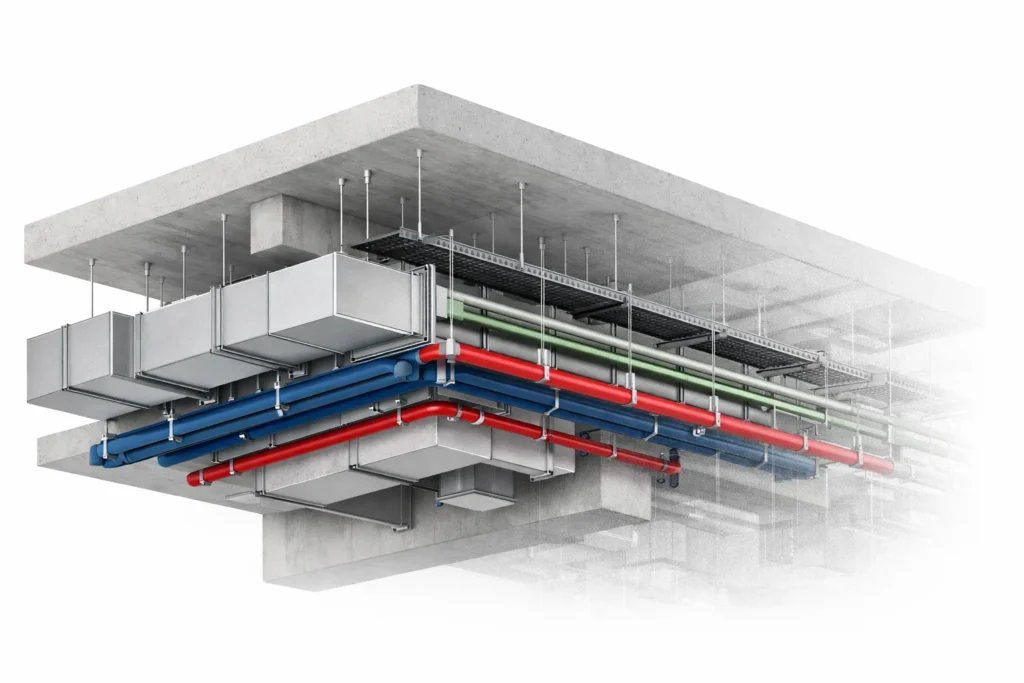
What Is a Point Cloud?
A point cloud is a dense collection of spatial data points captured using terrestrial laser scanners. Each point contains XYZ coordinates and may also include RGB colour and intensity data.
How It Is Generated
Laser scanners emit millions of laser pulses per second, measuring the time taken for each pulse to return. Multiple scan positions are captured across the site to ensure full coverage.
Common File Formats
- RCP / RCS (Autodesk Recap)
- E57
- LAS
- PTS
- XYZ
Accuracy Expectations
Professional laser scanning services Australia typically achieve ±2mm to ±5mm interior accuracy depending on scanner specification, range, and environmental conditions.
Step-by-Step Scan to BIM Workflow
1. Site Laser Scanning / Reality Capture
Technicians deploy calibrated scanners across the building to capture full spatial data. Coverage planning is critical to reduce occlusions and ensure reliable geometry capture.
2. Point Cloud Registration & Cleaning
Individual scans are registered using target-based or cloud-to-cloud alignment. Acceptable registration error typically remains below 3mm. Noise, reflections, and moving objects are removed during cleaning.
3. Data Verification & Alignment
Control points and survey benchmarks are verified. Alignment to Australian Height Datum may be required for infrastructure interfaces.
4. BIM Modelling in Revit
Using Revit point cloud modelling workflows, architectural, structural, and MEP systems are modelled directly from the verified point cloud. No assumptions are made beyond visible data.
5. LOD Definition for As-Built Model
LOD 300 to LOD 400 is typical for renovation projects. LOD 500 requires field verification beyond scan data. Model reliability is prioritised over graphical detail.
6. Quality Control & Clash Validation
Dimensional checks are performed against the point cloud. Clash detection using Navisworks or Revit ensures coordinated outputs.
7. Delivery Formats
- RVT
- IFC
- NWD
- 2D drawings
- Section views
LOD Levels in Scan to BIM Projects
LOD defines reliability and development level. For Scan to BIM projects:
- LOD 200 – Approximate geometry
- LOD 300 – Accurate size and location
- LOD 350 – Interface coordination
- LOD 400 – Fabrication-level detail
- LOD 500 – Verified as-built condition
Accuracy Tolerances
Typical modelling tolerances:
- Structure: ±5mm
- MEP routing: ±5–10mm
- Exterior long-range scans: ±10mm
Final model accuracy reflects scanner precision, registration quality, and modelling discipline.
Common Challenges in Reality Capture BIM
- Occlusions from insulation or plant
- Reflective stainless steel and glass interference
- Restricted access in live hospitals or industrial sites
- High ceiling congestion in commercial buildings
Applications of Scan to BIM in Australia
- Commercial renovations
- Heritage documentation
- Healthcare upgrades
- Industrial plant retrofits
- Facility management integration
Traditional Measurement vs 3D Laser Scanning
| Criteria | Traditional Measurement | 3D Laser Scanning |
|---|---|---|
| Speed | Slow and manual | Rapid data capture |
| Accuracy | Operator dependent | Consistent mm precision |
| Coverage | Selective | Comprehensive spatial dataset |
| Risk | High rework risk | Reduced construction risk |
Benefits of the Scan to BIM Process
- Reduced design risk
- Improved documentation accuracy
- Faster design mobilisation
- Enhanced clash avoidance
- Lifecycle-ready digital asset
Real-World Australian Example
During a major hospital upgrade in Melbourne, incomplete MEP documentation posed significant coordination risk. Full interior 3D laser scanning for construction was deployed across multiple levels. The result was a coordinated LOD 350 as-built BIM model delivered with verified alignment under 3mm registration error. The model revealed undocumented services and prevented costly rework during HVAC upgrades.
Frequently Asked Questions
What is the Scan to BIM Process?
The Scan to BIM Process converts point cloud data from laser scanning into a coordinated BIM model representing existing site conditions.
How accurate is point cloud to BIM modelling?
Interior projects typically achieve ±5mm modelling tolerance when professional workflows are applied.
What software is used?
Autodesk Recap processes point clouds. Autodesk Revit is used for BIM modelling.
What LOD is recommended for renovation?
LOD 300 to LOD 350 is standard for coordination and retrofit planning.
Is Scan to BIM suitable for hospitals?
Yes. It reduces shutdown risk and enables precise service coordination.
What formats are delivered?
RVT, IFC, NWD, and extracted 2D documentation.
Industry Standards, Global Alignment & Australian Expertise
The Scan to BIM Process aligns with global openBIM standards promoted by buildingSMART, ensuring interoperability, data integrity, and long-term asset usability. For complex retrofit, healthcare, and infrastructure projects across Australia, engaging an experienced consultancy is critical. MeterBuilt delivers specialist reality capture BIM solutions nationwide, combining field accuracy with disciplined modelling standards. With active delivery capability across major regions detailed on our Australian offices page, our teams support builders, asset owners, and engineers with high-precision Scan to BIM services designed for coordination certainty and long-term asset intelligence. Accurate data at project inception protects every downstream decision. The right Scan to BIM Process ensures measurable reality — not assumptions — defines your project baseline.